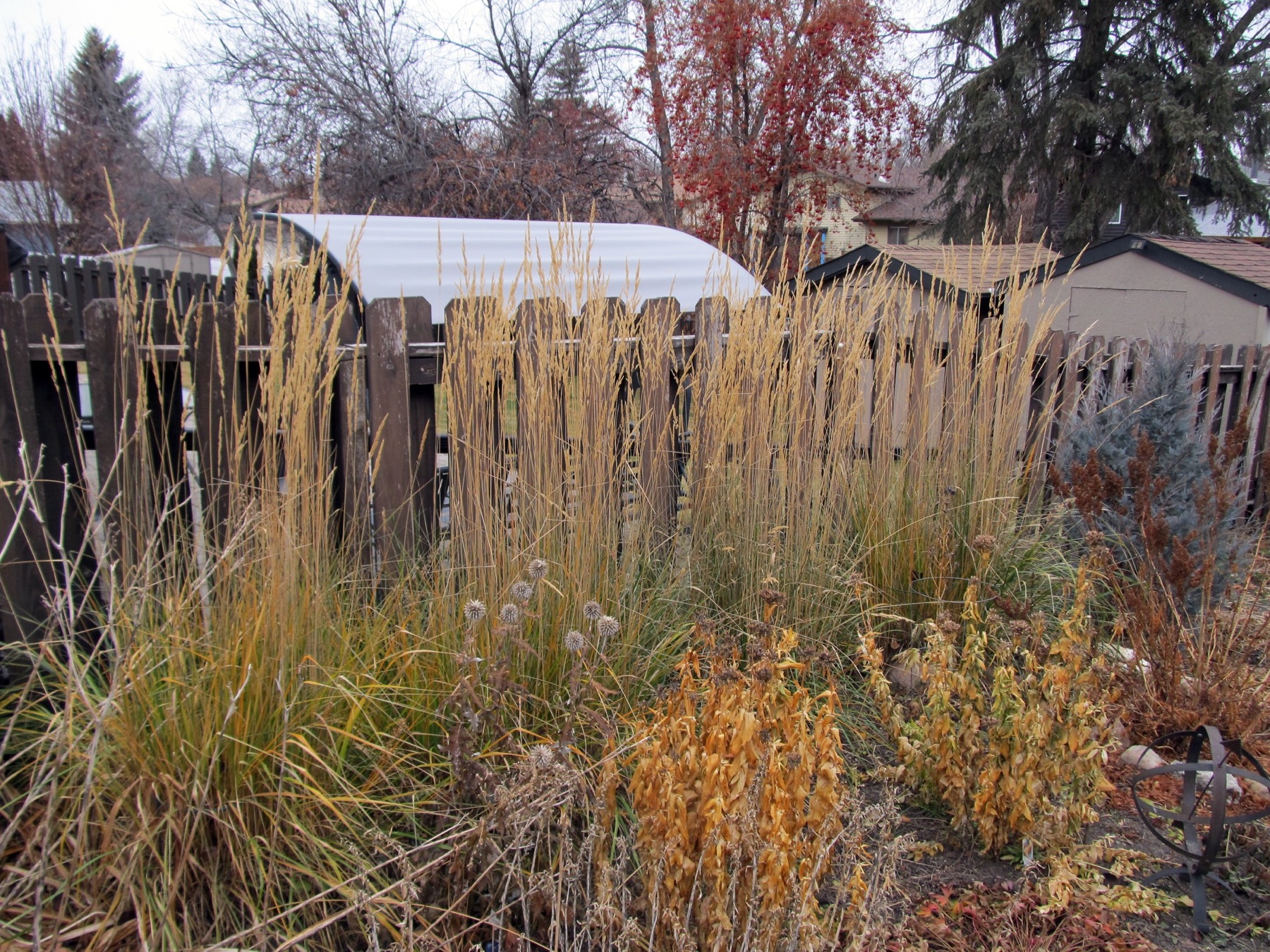
Winter interest in a xeriscape comes from four things: ornamental grasses left standing, evergreens that hold their shape and color, seedheads you don't cut down, and woody plants with good bark or berries. Plant some of each, leave the dead tops up until early spring, and a dry garden still looks designed in January.
That matters more in a xeriscape than in a lawn-and-shrub yard. There's no green turf to carry the view, and in cold-winter climates the beds are dormant for four or five months. This guide covers what to plant and where. For winter watering, drip shutdown and spring cutback timing, see how to winterize a xeriscape.
Grasses: the backbone from November to March
Grasses do more winter work than anything else in a dry garden. CSU Extension's ornamental grasses fact sheet notes that grasses add a significant vertical presence to the winter landscape and are commonly left standing until spring. It also recommends placing them to catch morning or evening light, and notes they look good against a dark background. Low winter sun through tan seedheads is the best thing a xeriscape does all winter.
- Little bluestem is the standout. The Lady Bird Johnson Wildflower Center describes its reddish-tan fall color persisting through winter snows, with fuzzy white seeds that are of particular value to small birds in winter. Plant Select says the seed heads of its 'Standing Ovation' selection remain upright through winter.
- Karl Foerster feather reed grass gives the strongest vertical line. CSU says its flower spikes form in May to June, turn golden, then bleach tan and persist into winter. It needs more summer water than the prairie natives.
- Blue oat grass is the cool-color option. The Missouri Botanical Garden notes it is evergreen in warm-winter climates but semi-evergreen in harsh winters, so expect some browning in cold-winter yards. NC State Extension warns against soil that stays wet through the winter.
- Switchgrass gives height. The Wildflower Center notes its yellow clumps last throughout the winter. CSU adds that it needs regular irrigation in Colorado's semiarid climate, so put it on the wetter end of the bed.
- Undaunted ruby muhly is a fine-textured mound for the front of a bed. Plant Select calls it "persistent winter beauty" and recommends siting it where the seed heads will be backlit.
Plant grasses in drifts rather than singly, and put them where you'll see them from a window. Our ornamental grasses guide covers sizes and summer care.
Evergreens: form and color when everything else is tan
By December, grasses and seedheads are all tan and copper. Evergreens supply the contrast in silver, blue-green and dark green, plus a solid shape. Space them through the bed as anchors so the yard keeps a skeleton when the perennials are down.
- Rocky Mountain juniper is a native upright evergreen with bluish-silver to dark green foliage, shedding reddish-brown bark, and waxy blue berry-like cones that feed birds and small mammals. It hosts cedar-apple rust, so keep it away from apples and crabapples.
- Pinyon pine is, in the Wildflower Center's words, a picturesque, gnarled evergreen with a compact, globose crown. It's slow, but one pinyon gives a small yard year-round structure.
- Big sagebrush is a silver evergreen with peeling grayish bark, according to CSU's native shrubs guide. The same guide notes it does not tolerate high moisture, so keep it off any irrigated zone.
- Curl-leaf mountain mahogany has thick, dark evergreen leaves and feathery seed heads (CSU) on a large shrub or small tree. Deer browse it, so protect young plants.
- Panchito manzanita is a native broadleaf evergreen groundcover that Plant Select lists for winter interest. It wants sharp drainage and seems to prefer afternoon shade.
- Yuccas and agave add bold rosettes. NC State Extension describes Adam's needle yucca as a broadleaf evergreen suited to winter gardens. Plant Select notes the arching evergreen leaves of red yucca, and Havard agave is evergreen too. More options are in cold-hardy agave and yucca.
For larger evergreen and deciduous shrub choices, see drought-tolerant shrubs.
Seedheads and stems: what to leave standing
Many perennials look as good dead as alive, if you leave them alone. Seedheads catch snow, hold frost, and give birds something to eat. These hold up best:
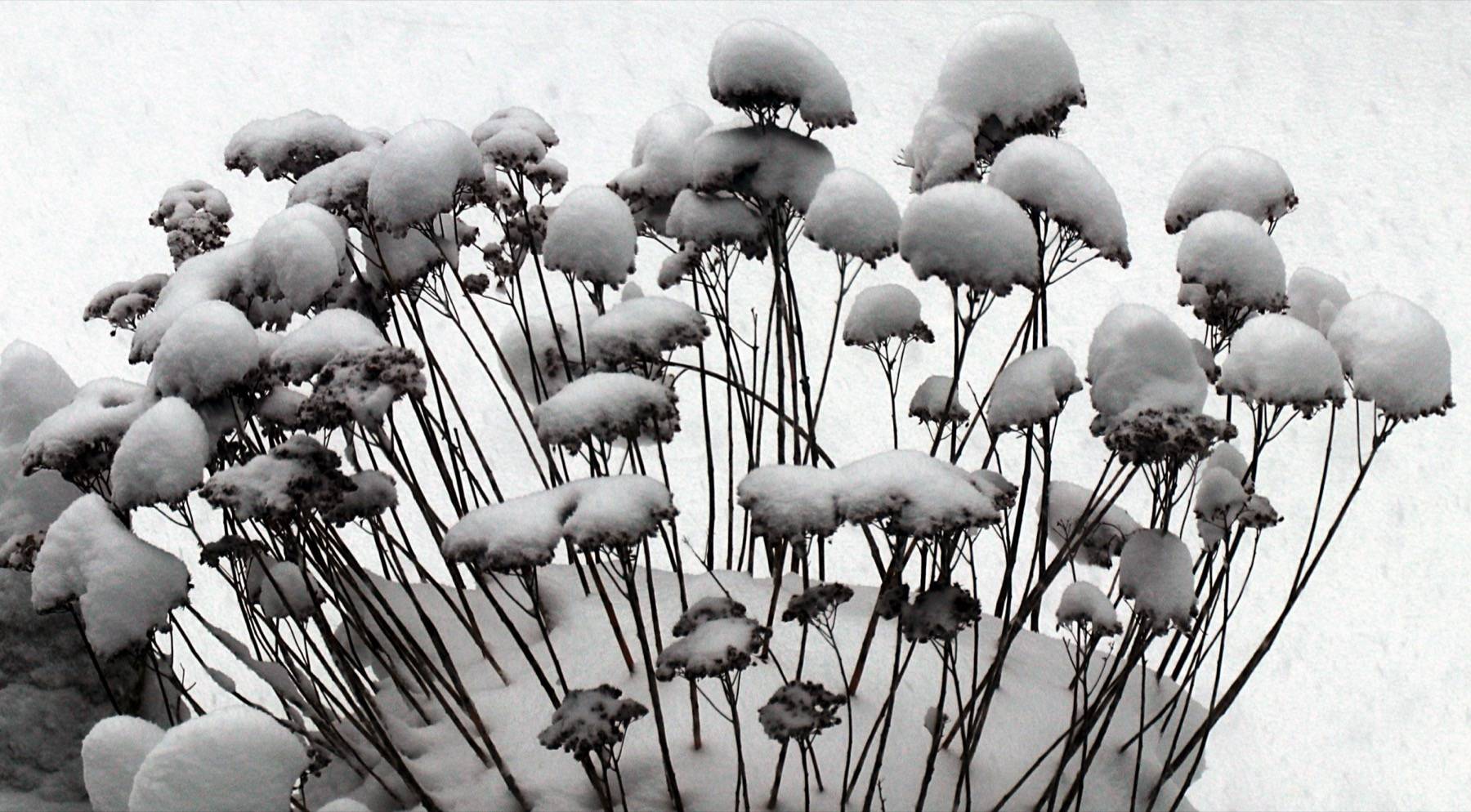
- Sedum 'Autumn Joy' is the classic snow-catcher in the photo at the top. The Missouri Botanical Garden notes that its foliage and dead flower heads persist well into the winter.
- Purple coneflower heads feed birds. NC State Extension says songbirds, especially American goldfinches, eat the seeds, and its dead stems are used by stem-nesting bees.
- Russian sage stays silver and upright. PlantTalk Colorado says its strong, upright shape provides a presence through the winter months, standing through wind and weather.
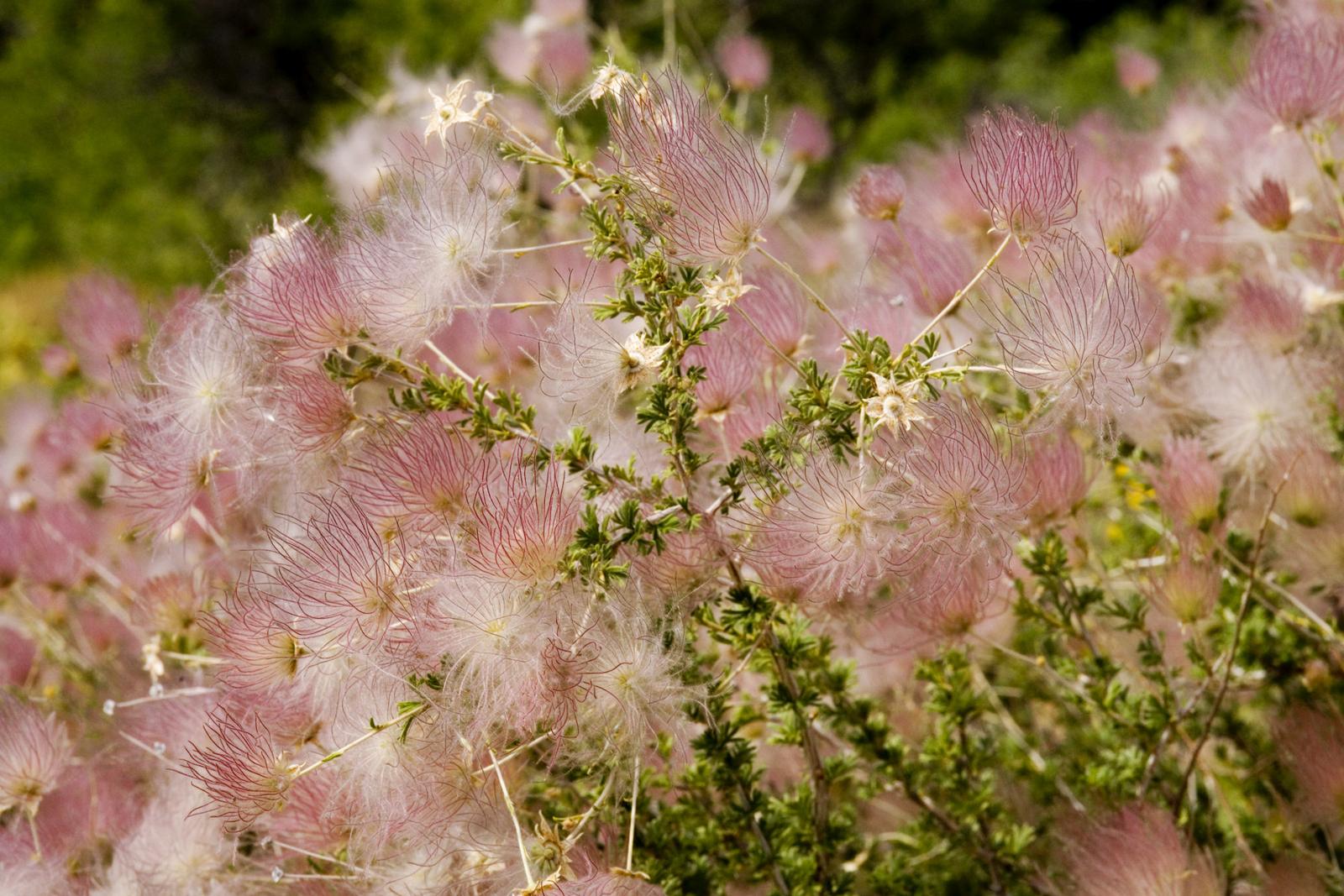
- Apache plume is a shrub, but it earns a spot here. Plant Select says its feathery pink seed heads provide a dramatic second act throughout the winter, and CSU notes its whitish, shreddy bark.
Standing stems also shelter insects. CSU Extension notes that some solitary bees nest in hollow stems, and that leaf litter shelters hibernating bumble bee queens. That's one more reason to delay cleanup. For more bee and bird plants, see pollinator plants for a low-water garden.
The rule of thumb: if a plant is still upright and holding its shape after the first hard frost, leave it. If it has collapsed into a wet mat, or it's diseased, tidy it. The cutback itself belongs in early spring, as laid out in the xeriscape maintenance calendar.
Bark, berries and branches
Bark and berries give interest at eye level, which matters once snow buries the low plants.
- Russian hawthorn is a small tree with what Plant Select calls gorgeous bark, plus red fall fruit that birds love. Plant Select lists it for winter interest.
- Common manzanita is the bark plant for warm-winter yards. UC Master Gardeners in Sonoma County describe its smooth, purplish mahogany bark as the main feature on mature plants, and note that manzanitas bloom heavily in winter, drawing hummingbirds.
- Toyon is the berry plant for zones 8–10. The Wildflower Center calls it very showy in winter with evergreen leaves and abundant red fruit, with berries lasting from November to February. Calscape lists robins, cedar waxwings and mockingbirds among the birds that eat them.
Winter-interest plants by zone
Zones and water needs below match our plant database. Water ratings are after establishment.
| Plant | Zones | Winter feature | Water |
|---|---|---|---|
| Little bluestem | 3–9 | Reddish-tan stems, white seed tufts | Very low |
| Rocky Mountain juniper | 3–7 | Upright evergreen, blue berry-like cones | Very low |
| Curl-leaf mountain mahogany | 3–8 | Dark evergreen leaves | Very low |
| Purple coneflower | 3–8 | Seed heads for goldfinches | Low |
| Sedum 'Autumn Joy' | 3–9 | Dried flower heads that hold snow | Low |
| Feather reed grass | 4–9 | Tan vertical plumes | Low |
| Blue oat grass | 4–8 | Blue foliage (semi-evergreen in cold winters) | Low |
| Switchgrass | 4–9 | Yellow-tan clumps | Low |
| Russian sage | 4–9 | Silver upright stems | Very low |
| Apache plume | 4–8 | Feathery seed heads, shreddy bark | Very low |
| Big sagebrush | 4–9 | Silver evergreen, peeling bark | Very low |
| Panchito manzanita | 4–8 | Broadleaf evergreen groundcover | Very low |
| Adam's needle yucca | 4–10 | Evergreen rosette | Very low |
| Russian hawthorn | 4–9 | Bark and branching | Low |
| Pinyon pine | 5–8 | Gnarled evergreen | Very low |
| Red yucca | 5–10 | Arching evergreen leaves | Very low |
| Havard agave | 5–9 | Blue-gray evergreen rosette | Very low |
| Undaunted ruby muhly | 5–10 | Fine tan mounds | Low |
| Common manzanita | 8–10 | Mahogany bark, winter flowers | Very low |
| Toyon | 8–10 | Red berries, November–February | Very low |
Zones 3–4. Build around little bluestem, Rocky Mountain juniper and curl-leaf mountain mahogany, with coneflower and 'Autumn Joy' for seedheads. Zone 4 adds feather reed grass, Russian sage, Apache plume, big sagebrush and Adam's needle yucca.
Zones 5–7. Nearly the whole list works. Add pinyon pine, red yucca, Havard agave and ruby muhly for structure. Rocky Mountain juniper tops out at zone 7.
Zones 8–10. Toyon and common manzanita do the heavy lifting, with little bluestem (to zone 9), ruby muhly, red yucca and Adam's needle yucca. Coneflower, blue oat grass, pinyon and Panchito manzanita top out at zone 8.
Not sure of your zone? Use the zone lookup, or read understanding USDA hardiness zones.
Designing for the winter view
- Plant for the windows. Decide which views you see most from November to March (kitchen, front walk, the street) and put the grasses and evergreens there.
- Mix the four sources. A bed of nothing but grasses reads as a field. Grasses plus one or two evergreens plus a seedhead perennial reads as a garden.
- Use dark backgrounds. CSU notes grasses look good against a dark background. A juniper, a dark fence or a boulder behind a drift of little bluestem makes the color stand out.
- Backlight what you can. Put grasses and ruby muhly between you and the low winter sun, east or west of the main view.
- Mind fire risk near buildings. CSU notes that dried grass foliage is combustible in winter and is likely best removed on public and commercial sites. If you live in a fire-prone area, apply the same caution to grasses planted right against the house.
Frequently asked questions
What plants give a xeriscape winter interest?
Ornamental grasses left standing (little bluestem, feather reed grass, switchgrass), low-water evergreens (juniper, pinyon, big sagebrush, yucca), perennials with sturdy seedheads (sedum 'Autumn Joy', coneflower, Russian sage), and woody plants with good bark or berries (Russian hawthorn, and manzanita or toyon in warm zones).
Should I cut back ornamental grasses before winter?
No. Leave them standing for winter structure and cut them back in early spring, before new growth starts. Remove only diseased or collapsed foliage in fall. The full timing is in how to winterize a xeriscape.
Which grasses look best in winter?
Little bluestem holds reddish-tan color through winter snows, feather reed grass keeps tan plumes upright into winter, and switchgrass forms yellow clumps that last all winter. Blue oat grass stays blue in mild winters but browns somewhat in harsh ones.
What evergreens work in a cold-winter xeriscape?
Rocky Mountain juniper (zones 3–7) and curl-leaf mountain mahogany (3–8) handle the coldest yards. Big sagebrush, Panchito manzanita and Adam's needle yucca are rated to zone 4, and pinyon pine, red yucca and Havard agave to zone 5. All are very low water once established.
Do seedheads left standing help wildlife?
Yes. Goldfinches eat coneflower seeds, and little bluestem seeds are of particular value to small birds in winter. Hollow stems give some solitary bees a place to nest, and leaf litter shelters hibernating bumble bee queens.