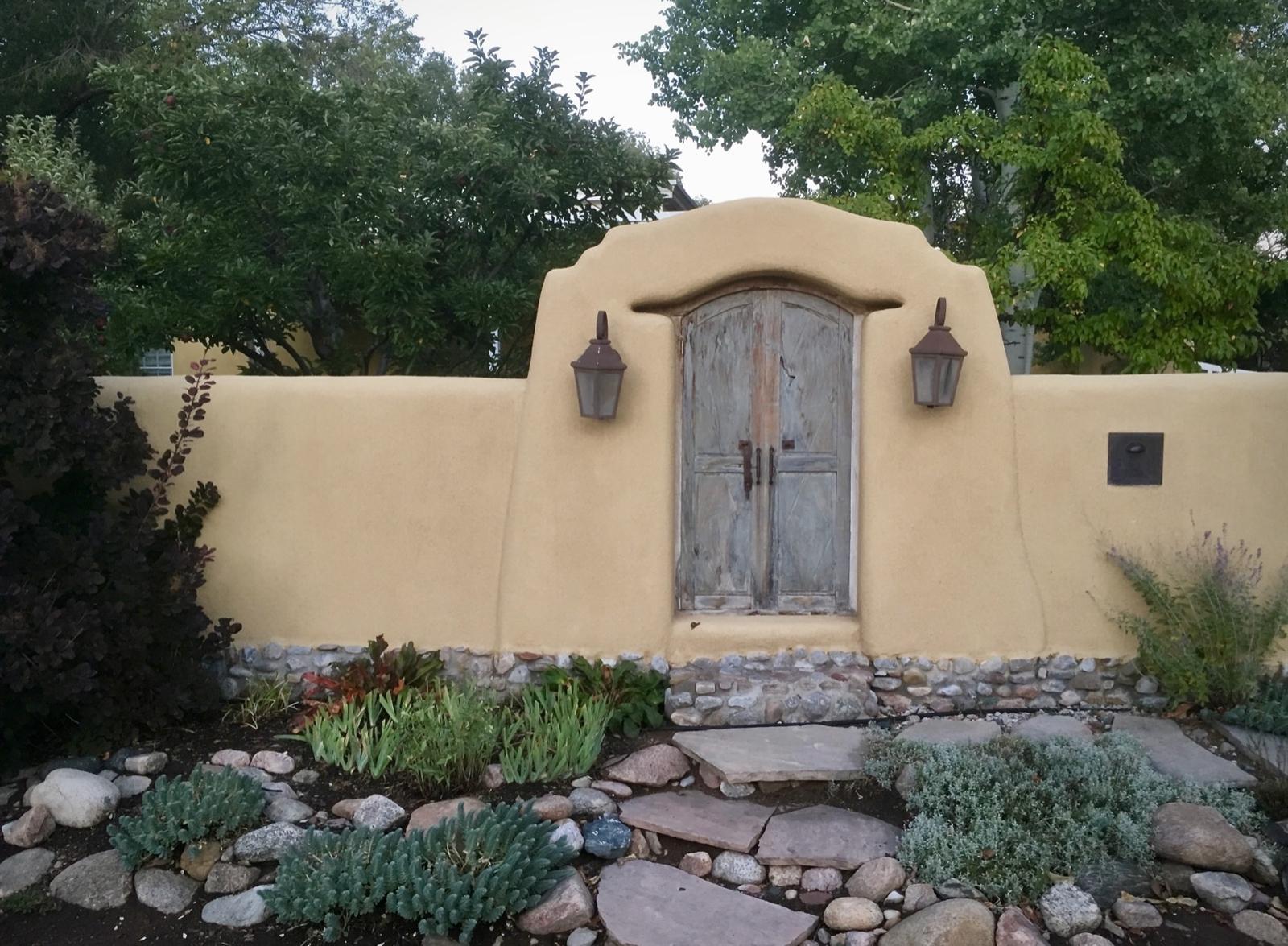
Xeriscaping in Santa Fe is less a trend than the way the city has always looked: adobe walls, flagstone, chamisa and piñon. Santa Fe sits near 7,000 feet, gets about 13 inches of precipitation a year and has one of the shortest frost-free seasons of any city we cover. Plants have to survive single-digit winter nights, blazing high-altitude sun and a dry, windy spring before the July monsoon arrives.
This guide covers Santa Fe's growing conditions, native and adapted plants that handle them, design ideas, the city's year-round watering rules and the rebates available as of September 2026.
Santa Fe growing conditions
- USDA zones 6b and 7a. On the 2023 USDA map, 87501, 87505 and 87540 are 6b, while 87506, 87507 and 87508 are 7a. Low spots and canyon bottoms run colder. See our Santa Fe zone page.
- Precipitation. NOAA's 1991–2020 normals put the in-town Santa Fe 2 station at 12.79 inches a year and the municipal airport at 10.71 inches. July (2.26 inches) and August (2.04 inches) are the wettest months in town (NOAA monthly normals).
- Short season. At Santa Fe 2, the median last spring freeze is May 14 and the median first fall freeze is October 6, a growing season of about 144 days. The airport's medians are May 4 and October 15 (NOAA annual normals).
- Cold nights, mild days. January's mean low at Santa Fe 2 is 17.6°F. July's mean high is 85.8°F, much milder than Albuquerque, but the sun is intense at this elevation.
- Elevation. Santa Fe 2 sits at about 6,760 feet and the airport at about 6,290 feet.
- Know your soil. NMSU Extension's tree guide lists the soil conditions to check before planting in New Mexico: depth, drainage, caliche layers, texture, pH and salinity (NMSU H-328). If you hit caliche, break through it at each planting hole.
The best xeriscape plants for Santa Fe
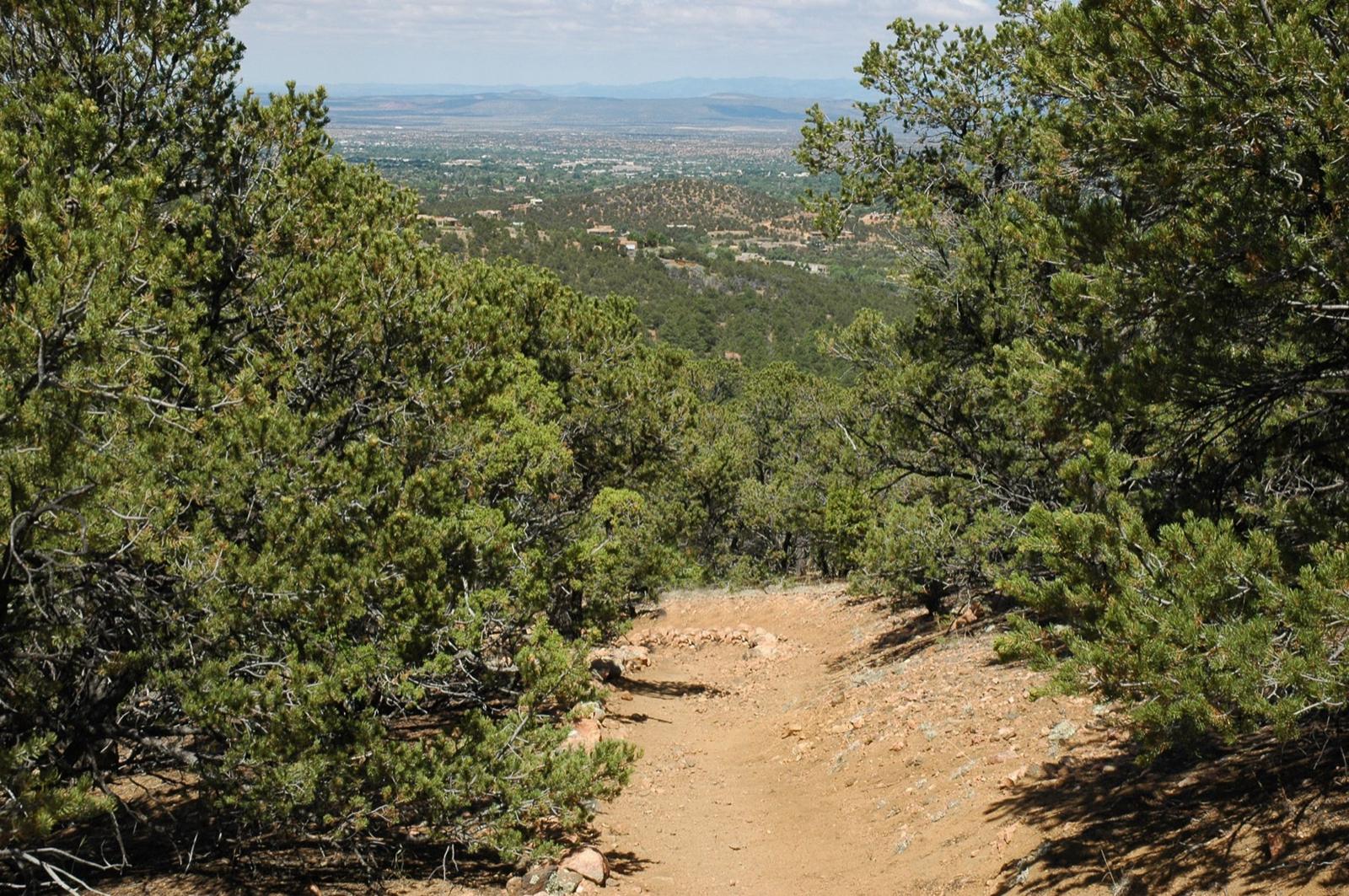
The hills around Santa Fe are a ready-made plant list: piñon and one-seed juniper, chamisa (rabbitbrush), Apache plume and blue grama. The city's Waterwise Landscape page lists what grows in its Water Conservation Demonstration Gardens, including a non-cactus garden donated by the Santa Fe Master Gardeners and a mostly native cactus garden that needs no irrigation.
| Plant | Type | Zones | Water | Why it works here |
|---|---|---|---|---|
| Pinyon pine | Tree | 5–8 | Very low | The Santa Fe tree. Slow, evergreen and drought-proof on well-drained soil |
| One-seed juniper (Juniperus monosperma) | Tree | 4–8 | Very low | Native evergreen for screening and wind breaks |
| New Mexico privet (Forestiera pubescens) | Tree | 4–9 | Very low | Native multi-trunk small tree. Early bloom for bees |
| Rabbitbrush (chamisa) | Shrub | 4–9 | Very low | Gold fall bloom along every Santa Fe roadside |
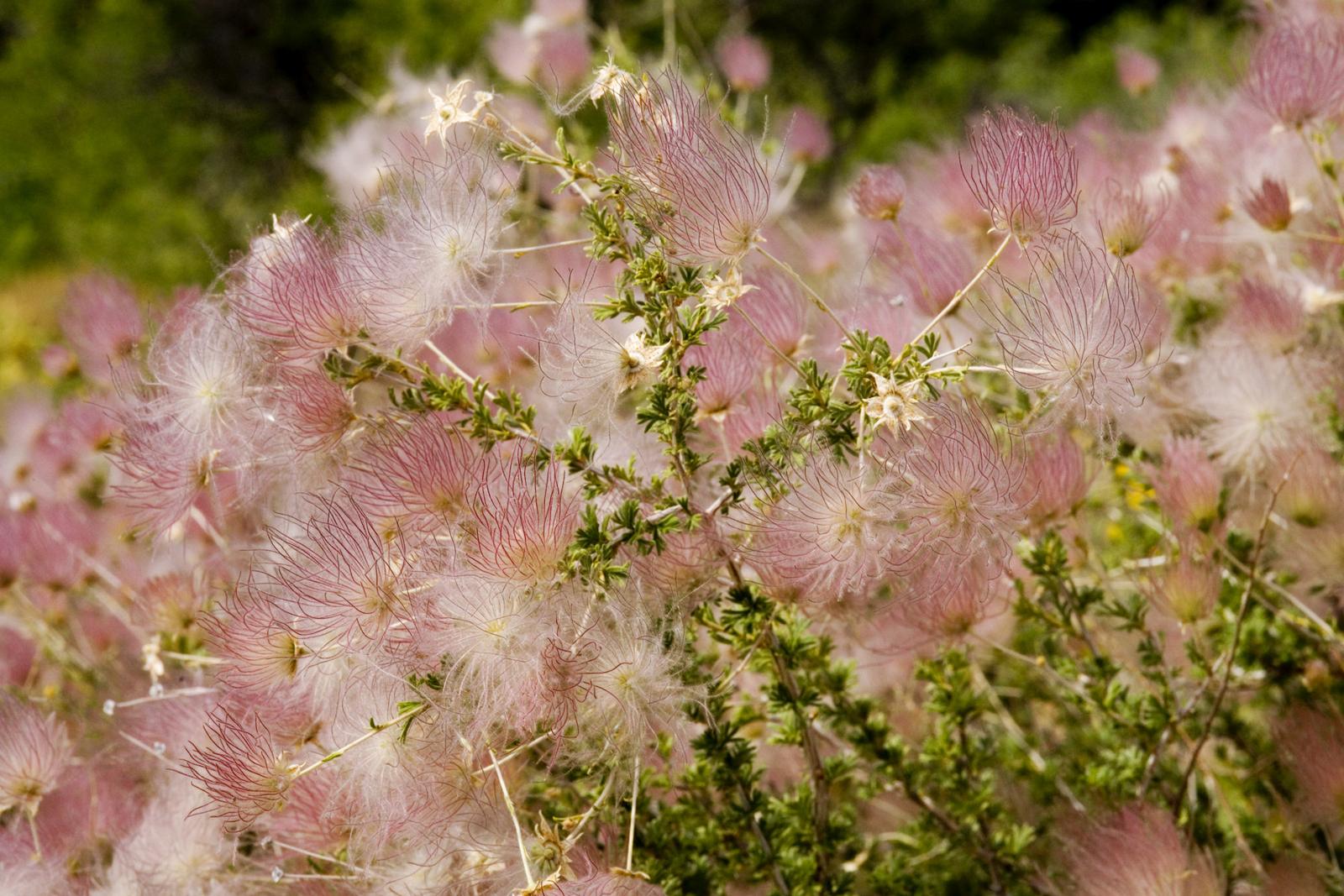
| Apache plume | Shrub | 4–8 | Very low | White flowers and pink feathery seed heads from spring to fall |
| Fernbush | Shrub | 4–8 | Very low | Fragrant white summer bloom. Semi-evergreen structure |
| Three-leaf sumac | Shrub | 4–8 | Very low | Native hedge with red fall color and bird berries |
| Rocky Mountain penstemon | Perennial | 4–9 | Very low | Blue spring spikes. Reseeds in gravel |
| Chocolate flower | Perennial | 4–9 | Very low | Featured in the city's demonstration gardens. Smells like cocoa |
| Desert four o'clock (Mirabilis multiflora) | Perennial | 5–10 | Very low | Magenta evening flowers. Dies back to a deep root each winter |
| Claret cup cactus | Cactus | 5–9 | Very low | Native hedgehog cactus with scarlet spring flowers |
| Blue grama | Grass | 3–10 | Very low | Native bunchgrass for meadows or a mowable lawn alternative |
Watch zone-8 plants from Albuquerque and farther south. Desert willow is rated for zones 7–11, so it's a gamble outside sheltered 7a spots. For more cold-tolerant options, see xeriscape plants for zone 6 and cold-hardy cactus.
Design notes for the high desert
Work with the architecture. Earth-toned walls, flagstone and local rock are the Santa Fe look. A walled courtyard also creates a warmer microclimate, where you can grow 7a plants even in a 6b neighborhood.
Harvest the monsoon. July and August bring about a third of the year's precipitation, often in short, hard storms. Slope patios and paths toward planted basins, and run canales (roof scuppers) into rock-lined channels rather than onto bare soil. The city offers cistern rebates (below) if you want to store roof water. A dry creek bed can carry storm runoff to where plants need it.
Plan for a short season. With frost possible into mid-May, plant perennials and shrubs from late May through August, or in September if you can water through the fall. Early planting gives roots time before winter. Plants set out in October have little time to root and can heave out of the ground in freeze-thaw cycles.
Give trees room. NMSU Extension notes that most tree roots are in the top 18 inches of soil and can spread 1.5 or more times the tree's height from the trunk. Place drip emitters out toward the edge of the canopy as trees grow, not at the trunk.
Drip only for shrubs and trees. Santa Fe prohibits overhead spray irrigation for watering trees and shrubs. See how to install drip irrigation for a layout that also keeps you under the city's rules.
Santa Fe watering rules
The City of Santa Fe has year-round water rules for residential customers (Water Conservation Rules and Regulations):
- No outdoor watering between 10 a.m. and 6 p.m. from May through October. The city recommends watering no more than three times a week.
- No overhead spray on trees and shrubs. Use drip or other low-volume irrigation.
- No overspray or runoff while watering.
- Permits are required for all new irrigation systems and for major renovations of existing ones, and a certified backflow prevention device is required for systems on city water.
- Automatic shut-off nozzles are required on hoses used for hand watering.
- Turf seed or sod must contain less than 25 percent Kentucky bluegrass.
If the city declares a water emergency, stricter stages apply. Under a Water Warning ("Orange"), landscape irrigation is limited to twice a week by odd or even address. Under a Water Crisis ("Red"), almost all outdoor irrigation with drinking water stops (City drought page).
Santa Fe rebates (as of September 2026)
The City of Santa Fe doesn't currently list a turf-removal or xeriscape rebate. Its outdoor rebates cover rainwater catchment and irrigation equipment.
| Program | Amount | Cap | Key requirement | Link |
|---|---|---|---|---|
| Rain barrels (small-volume catchment) | $12 each (50–99 gal), $25 (100–199 gal), $50 (200–499 gal) | Four rain barrels per household | Overflow, secure lid, screen and tap required | City of Santa Fe |
| Cisterns (large-volume catchment) | $0.25/gallon, plus $0.125/gallon bonus if sized for 2 inches of rain on the roof, plus $0.25/gallon for indoor toilet flushing | No overall cap published | Indoor-use bonus requires code-compliant plumbing and a building permit | City of Santa Fe |
| Irrigation equipment | Rain sensor $40; soil moisture sensor $75; WaterSense ET controller up to $400 (up to 12 stations) or $750 (more than 12) | Cost of the controller | City of Santa Fe water customers | City of Santa Fe |
| Turf removal / xeriscape rebate | None listed | n/a | Not currently offered by the city | City of Santa Fe |
Check the rules before you buy. These rebates are paid after purchase: apply with receipts within six months. Confirm current terms with the Water Conservation Office before you order a cistern. If you live outside city limits or on a private well, these city programs may not apply; check with your own provider.
HOAs and covenants
If your neighborhood has a design review committee, submit a plan and plant list before you start. We couldn't confirm a New Mexico statute that guarantees xeriscaping rights in HOAs, so read your covenants and ask the association in writing if anything is unclear.
Hire it out
Rock work, flagstone and cistern plumbing are where Santa Fe projects get expensive, and a new irrigation system needs a city permit. A local installer will know the permit process and which plants survive in your neighborhood's microclimate. Ask for itemized bids and compare them with our xeriscaping cost guide. Browse listed pros in Santa Fe:
Heading downhill? Our Albuquerque xeriscaping guide covers the warmer Middle Rio Grande Valley and ABCWUA's turf rebate.
Frequently asked questions
When can I water in Santa Fe?
From May through October, outdoor watering is prohibited between 10 a.m. and 6 p.m., and the city recommends watering no more than three times a week. Trees and shrubs can't be watered with overhead spray. Stricter limits apply if the city declares a water emergency.
Does Santa Fe have a lawn removal rebate?
Not as of September 2026. The City of Santa Fe's outdoor rebates cover rain barrels, cisterns, rain sensors, soil moisture sensors and WaterSense ET controllers. Albuquerque's water utility runs a xeriscape rebate, but Santa Fe's doesn't.
What is the last frost date in Santa Fe?
NOAA's 1991–2020 median last spring freeze is May 14 at the in-town Santa Fe 2 station and May 4 at the municipal airport. Wait until mid- to late May to plant anything frost-tender.
What trees grow well in Santa Fe without much water?
Piñon pine, one-seed juniper and New Mexico privet are all native and need very little water once established. Plant them in well-drained soil, water deeply through the first two summers and move emitters outward as the canopy grows.