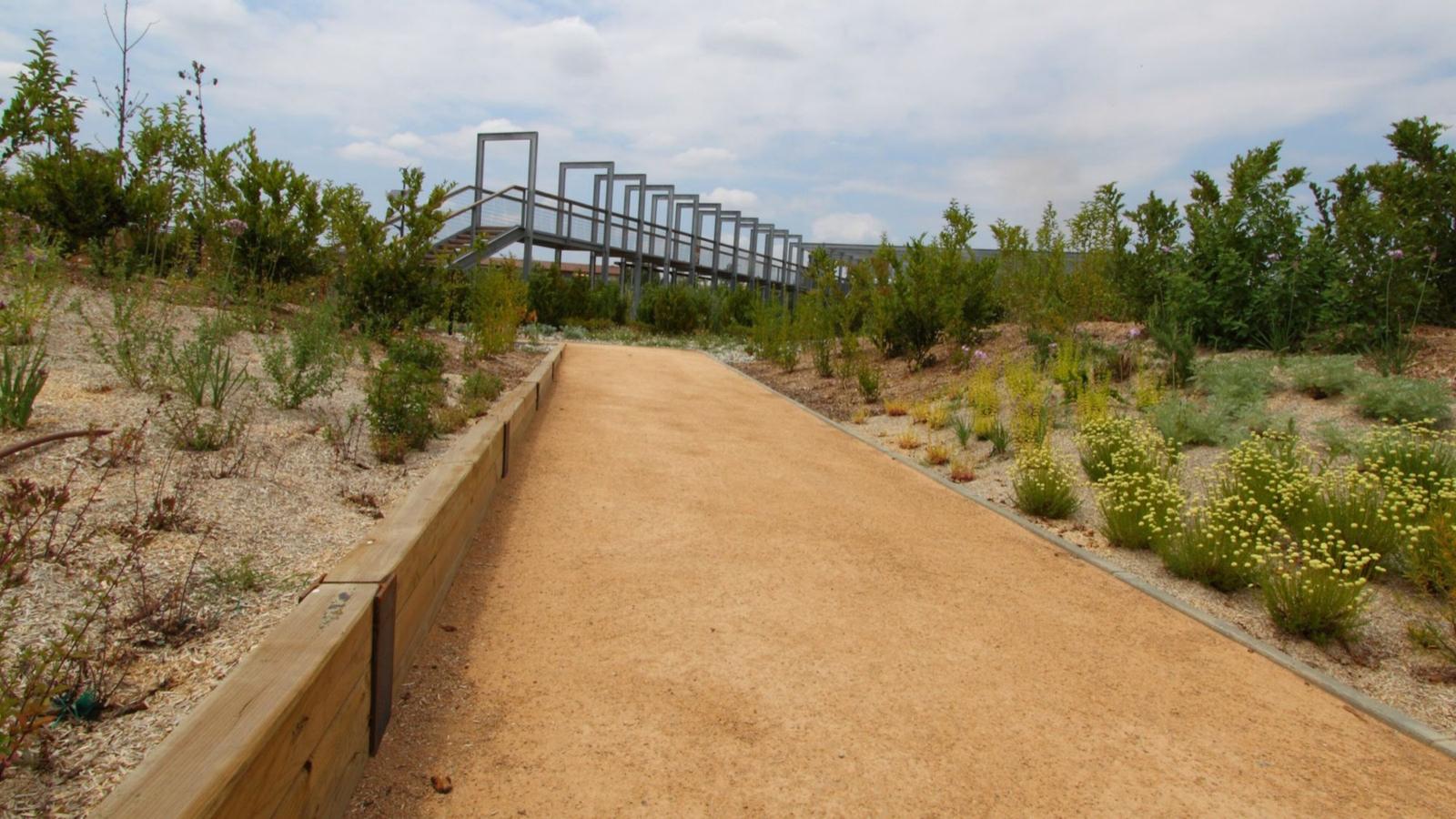
To build a decomposed granite path that stays firm, you need five things. Dig out 4–6 inches. Set rigid edging. Build a compacted base if your soil is soft or clay. Spread DG in 3–4 inch layers, moistened and compacted with a plate compactor. Give the surface a slight cross slope so water sheds off instead of sitting on it. The U.S. Access Board's guidance for firm, stable outdoor surfaces says crushed rock with a full range of particle sizes, compacted moist in 3- to 4-inch layers, beats loose material that's left to pack down under foot traffic. That's the difference between a path that feels like a sidewalk and one that feels like a beach.
Decomposed granite, or "DG," is granite weathered down into sand and fine gravel. It's cheap, permeable and natural-looking, which is why it shows up in so many xeriscapes. Here's how to pick the right kind and build it right.
Loose, stabilized or resin-bound DG?
| Type | What it is | Best for | Trade-offs |
|---|---|---|---|
| Loose (natural) DG | Crushed granite with its fines, compacted | Garden paths, patios with light use, around plants | Softens when wet. Tracks onto shoes. Top-dress every few years |
| Stabilized DG | DG blended with a binder (typically plant-based) before compacting | Main walks, gentle slopes, near doors | Firmer and less tracking. Must be mixed, watered and compacted correctly. Costs more |
| Resin-bound DG | DG bonded with resin into a hard, porous surface | High-traffic walks, accessible routes | Closest to pavement. Least forgiving to install. Hardest to repair or remove |
All three work best with crushed material that includes fines. The Access Board's construction tips favor crushed rock over uncrushed gravel, broken-faced rock over rounded rock, a mix with a full spectrum of sizes including fines, and rock that passes a ½-inch screen. Rounded pea gravel rolls underfoot and never locks up. If you want gravel, see gravel vs. wood mulch for where it fits instead.
Materials and quantities
| Layer | Depth (compacted) | Material |
|---|---|---|
| Subgrade | — | Native soil, excavated and compacted |
| Separator (optional) | — | Woven geotextile on very soft or clay soils, under the base only |
| Base | 3–4 in on clay or soft soil; can skip on firm, well-drained native soil | Crushed road base with fines |
| Surface | 2–3 in | DG: loose, stabilized or resin-bound |
| Edging | Top set at finished grade | Steel, aluminum, stone, concrete paver or timber |
To estimate volume, multiply length × width in feet × depth in inches ÷ 12 ÷ 27 to get cubic yards. A 30-foot path 3 feet wide at 3 inches is about 0.8 cubic yard of DG. Order extra, because loose DG compacts down. Suppliers sell by the ton or yard, and the calculator converts both.
Tools: flat spade, wheelbarrow, steel rake, garden hose with a mist nozzle, a string line and level, and a plate compactor from a rental yard. A hand tamper works for small patches, but a plate compactor makes the path.
Step 1: Lay out the route and plan the slope
Mark both edges with paint or string. For a main garden path, 36–48 inches is comfortable. The Access Board's minimum clear width for an accessible trail is 36 inches, a good floor for anything you'll push a wheelbarrow down.
Plan drainage now. Water is what ruins DG. The Access Board allows unpaved surfaces a cross slope of up to 1:20 (5%) where needed for drainage. The Forest Service's trail construction notebook calls for outsloping tread about 5% so water moves across the trail rather than down it. In a yard, slope the path gently to one side, toward a planting bed or dry creek bed, and never toward the house. On a steep route, add steps rather than asking DG to hold a slope. Xeriscaping a slope covers terraces and steps.
Step 2: Call 811 and excavate
Call 811, the free national before-you-dig service, a few business days before you dig so buried utility lines get marked. Remove sod, roots and topsoil to 4–6 inches below finished grade: about 2–3 inches for DG plus 3–4 inches of base on clay or soft soil. Keep the bottom of the trench parallel to the finished surface, including the cross slope. Then run the plate compactor over the subgrade.
Step 3: Install the edging
DG migrates without a hard edge. Set steel, aluminum, stone or paver edging along both sides, staked or set in concrete per the product. Keep the top of the edging at or just above the finished DG surface. Too low and the path spreads into the beds. Too high and it's a trip edge. Steel edging disappears visually and makes clean curves. Stone or pavers suit a more rustic xeriscape.
Step 4: Build and compact the base
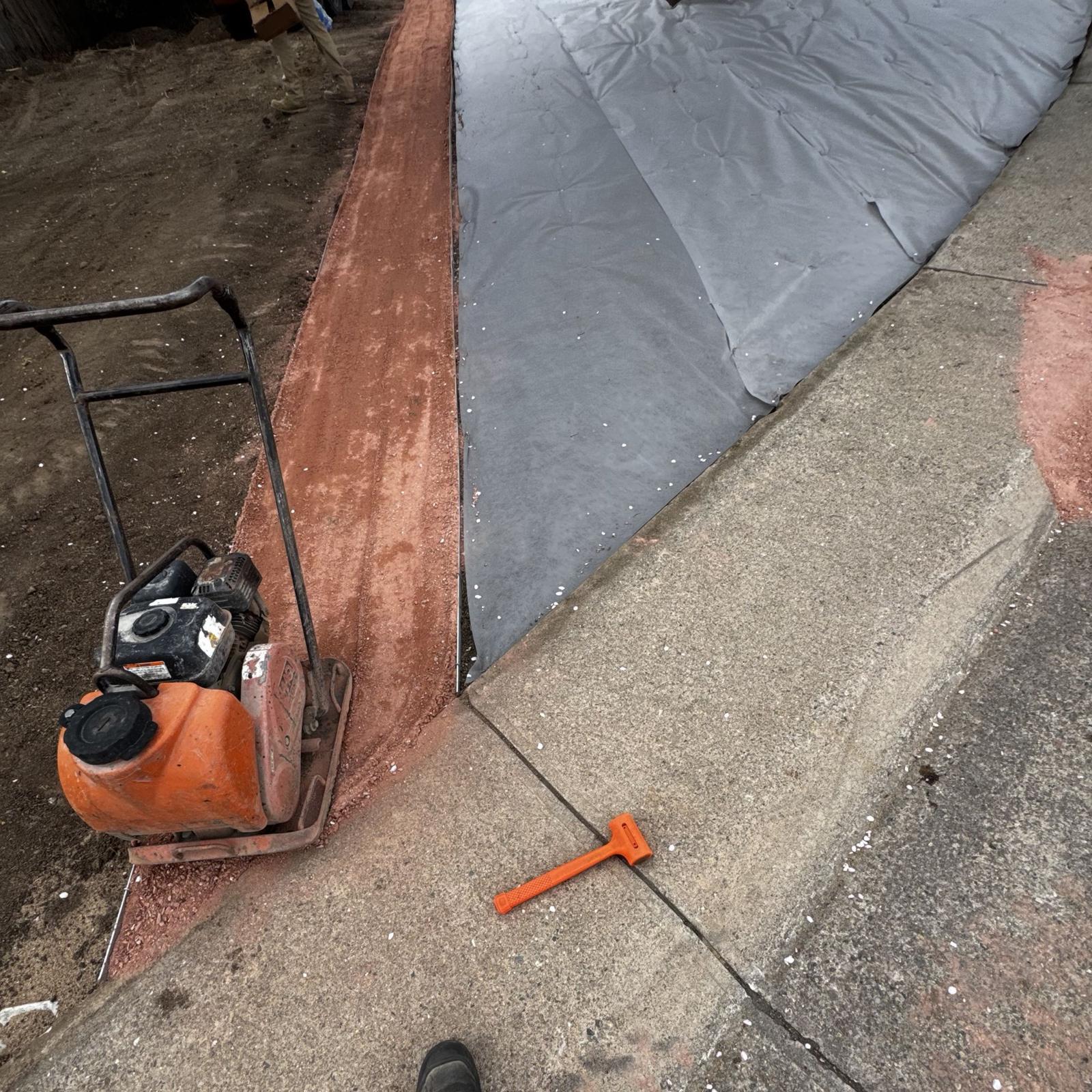
On clay or soft soil, lay a woven geotextile separator first if you're using one. Then spread road base in a single 3–4 inch layer, moisten it, and compact it with the plate compactor until it doesn't move underfoot. The Access Board's tips apply here too: moist (not wet) material, compacted in layers no thicker than 3–4 inches. On firm, well-drained native soil, a compacted subgrade can serve as the base.
A note on fabric: CSU Extension's mulching guide says a correctly deep mulch doesn't need a fabric underlayment. In a path, fabric's job is different. It keeps base rock from pushing into soft clay. Put it under the base, never directly under the DG, where it just becomes a slip layer that eventually shows through.
Step 5: Spread, moisten and compact the DG in lifts
Spread a lift of DG no more than about 4 inches deep and rake it level with the cross slope. Mist it until it's damp through but not muddy, then run the plate compactor in overlapping passes, first lengthwise and then crosswise. Repeat until you reach finished grade, keeping each lift no more than 3–4 inches thick. Fill low spots between lifts, not after.
For stabilized DG, follow the binder manufacturer's mixing ratio and water instructions exactly. The binder usually has to be blended evenly through the DG before it's placed, then activated with water and compacted while damp. For resin-bound DG, the manufacturer's installation instructions and cure times rule. Most homeowners hire this part out.
Step 6: Finish, water in and cure
Mist the finished path and let it dry. For natural DG, a couple of wet-and-dry cycles help the fines lock together. For stabilized DG, keep traffic off for as long as the product specifies. Sweep loose surface grit toward the edges and back into low spots.
Step 7: Plant the edges
Soft edges make a DG path look like it belongs. Low mat-formers like creeping veronica and hens-and-chicks, or tufts of blue grama, can spill over the edging without taking over the path. Plant Select's guide to planting among flagstones has more steppable options. Keep drip emitters out of the path itself. Constant moisture softens DG.
Maintenance
- Rake and re-compact soft or rutted spots. Mist first, then tamp.
- Top-dress loose DG with a thin layer every few years as fines wash or wear away.
- Pull weeds while they're small. Seeds land in the fines like they do in any gravel. How to stop weeds in gravel covers prevention.
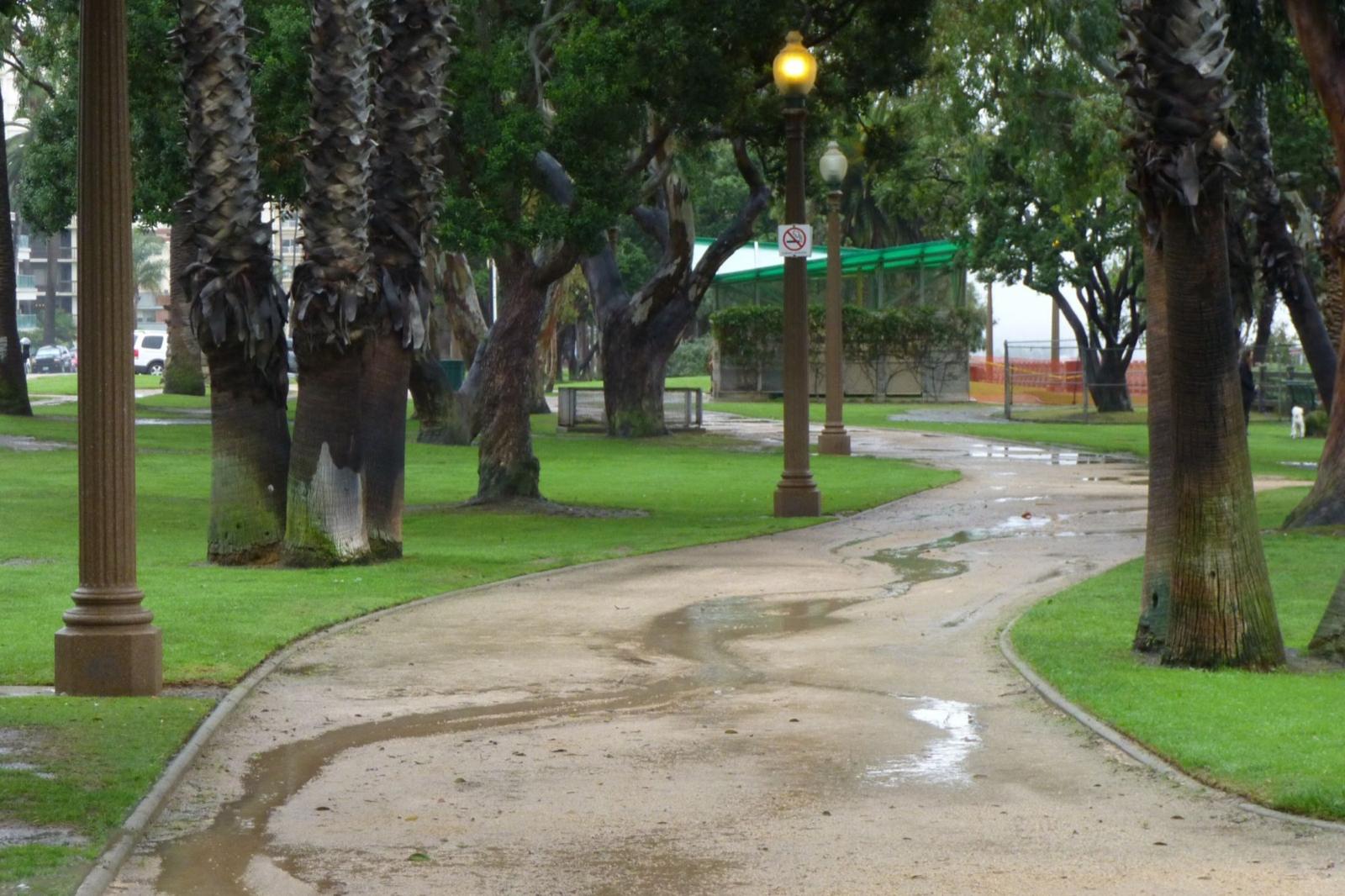
- Keep downspouts and sprinkler overspray off the path. Concentrated water is DG's main enemy.
- Add a doormat or a strip of pavers at house entries to catch tracked grit.
From our installs
On Front Range clay, the DG paths that fail are almost always missing either a compacted base or real edging. Clay heaves and softens when wet, and loose DG sitting straight on it turns to paste in spring and ruts by summer. The builds that last are compacted in thin, damp lifts with a plate compactor, not just raked flat and walked in. Where a path gets daily use, like an entry or the main route from the driveway, stabilized DG is worth the extra cost. Loose DG is fine farther out in the garden, where a little softness doesn't matter. Keeping downspouts from discharging onto the path saves more repair work than anything else.
Frequently asked questions
How deep should a decomposed granite path be?
Plan on 2–3 inches of compacted DG over 3–4 inches of compacted base on clay or soft soil, so dig 4–6 inches in total. On firm, well-drained soil, a compacted subgrade can replace the base.
Do I need a base under decomposed granite?
On clay, soft or poorly drained soil, yes. A compacted crushed-rock base keeps the path from rutting and heaving. On firm, sandy or gravelly native soil, compacting the subgrade well may be enough for a light-use garden path.
Should I use stabilized or loose DG?
Use stabilized DG for main walks, near doors and on gentle slopes, where firmness and low tracking matter. Use loose DG for secondary garden paths and around plants, where it's cheaper and easy to repair.
Is a decomposed granite path permeable?
Loose and stabilized DG let water soak in, which is one reason they suit xeriscapes and rain-friendly yards. Compacted DG still sheds heavy rain, though, so give the surface a slight cross slope toward a planting bed.
Should I put landscape fabric under decomposed granite?
Not directly under the DG. On soft clay, a woven geotextile under the base layer can keep the base from sinking into the soil. Directly under the DG, fabric creates a slip layer and eventually shows through.